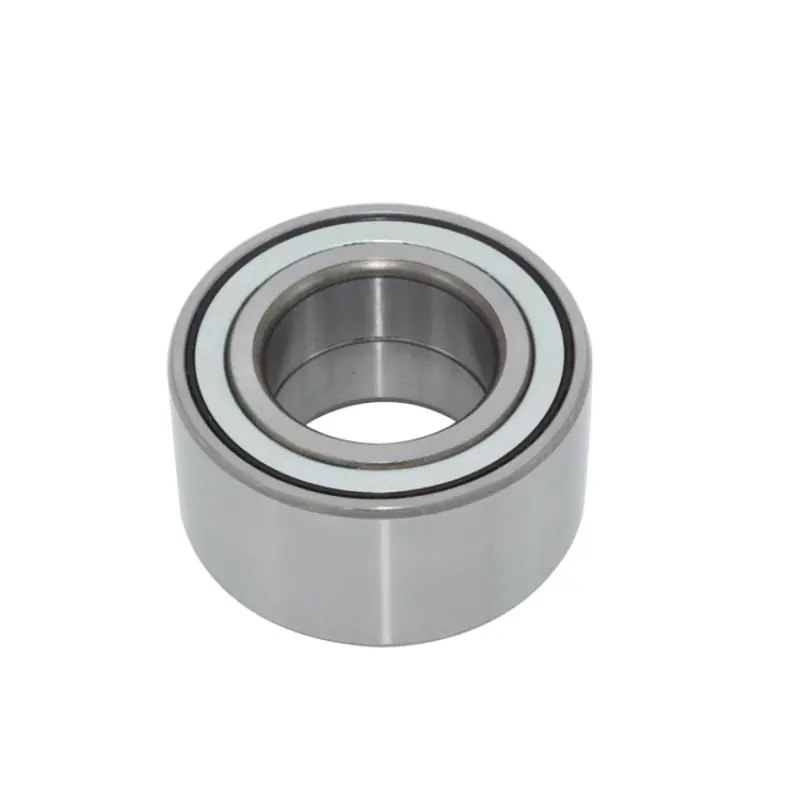
A wheel hub bearing is a wear-to-failure part, not a service part. Nobody replaces one on schedule — it gets replaced when it makes a noise or fails an inspection. Four symptoms account for almost every replacement.
1. Noise that changes with cornering load
The classic sign is a hum or growl that rises with road speed, then gets louder or quieter when the car is steered gently left and right at a constant speed. Loading the outside wheel in a corner increases the load on that bearing. If the noise grows when you steer right, the left bearing is usually the one at fault, because the left wheel is the loaded one.
Noise that changes with engine speed rather than road speed is not a bearing. Noise that changes only when braking is usually a disc or pad problem.
2. Radial play
With the wheel off the ground, grip it at the 12 and 6 o'clock positions and rock it. Any detectable movement, once suspension joints have been ruled out, points at the bearing. Gripping at 9 and 3 o'clock tests the steering linkage instead, which is why the two checks are often confused.
3. An ABS light that comes and goes
Generation 3 hub units carry a magnetic encoder ring moulded into the seal. When the seal degrades or the encoder is damaged during fitting, the ABS sensor loses signal intermittently — often only at low speed, often only when warm. The fault code points at the sensor; the actual cause is frequently the hub unit.
This is also the most common way a cheap hub unit reveals itself. The bearing may still turn quietly while the encoder has already stopped producing a clean signal.
4. Heat
After a motorway run, a failing bearing is measurably hotter than the same bearing on the other side of the vehicle. An infrared thermometer on the hub centre is a fast way to confirm a suspicion before the wheel comes off.
What causes early failure
In our experience three things account for most premature failures: contamination past a poor seal, incorrect preload from a bearing pressed in without the right tooling, and low-grade steel or balls that brinell under shock load. The first is a design and sealing question, the second is a workshop question, and the third is a sourcing question.
That third one is where a distributor's choice of supplier actually shows up. Our partner forges from Xingcheng Special Steel and uses G10-grade balls from Tsubaki Nakajima, Japan, and every unit gets 100% ABS sensor testing before it is packed.